


 Menu
Menu


Public sector focus: Striving for sustainability
Higher education caterers play a key role in minimising environmental impact, and there are plenty of ways to market that commitment to customers, says Julie Barker, chair of the University Caterers Organisation
When done effectively, marketing has real power, particularly when conveying positive messages such as sustainability and social responsibility. And as a YouGov survey found that 38% of respondents would be more likely to visit an outlet that minimised its impact on the environment, this is clearly an issue that students, staff and the wider community are keen to engage with.
We want students to not only enjoy the food that a university provides but also to be confident that they have actively chosen an on-campus outlet because of its credentials, in particular its sustainability achievements. Students and staff will only know that their âgreen needsâ are being met if they are being told so and, essentially, this comes down to presentation of information.
Marketing in campus outlets is a great place to start. Proudly and clearly advertise every accolade, accreditation and activity on posters and menus â" such as your Catering Mark from the Soil Association, your sustainable business Catey, or that you only use MSC-certified fish â" signpost your sustainability endeavours. Every certification is another example of the priority placed on âbetter sourcingâ, âreducing wasteâ, or one of the other many other areas which higher education caterers are leading on. This can also be done by using logos next to dishes which contain sustainably sourced produce or placing catering marks at the top of menus.
But what if customers arenât coming through the door in the first place? A fast and easy way to disseminate information is through social media.
Social media is of course vital when it comes to free ways of marketing your establishment. Using platforms such as Twitter allows you to instantly engage with the target market and create relationships with both students and suppliers. You can update followers with quick facts on a daily basis, whether itâs the dish of the day, how many food miles have been saved since switching suppliers or an outletâs most recent waste reduction statistics. And try to keep it fun and interesting.
Mouth-watering pictures posted on Facebook, accompanied with sustainability statements, will drive interest and make customers want to visit an outlet.
But while Instagram and Facebook are great places to share information and pictures, you also have to remember that itâs a two-way conversation. Youâll need to follow, like and get people involved in the wider conversation to grasp attention and increase custom.
The range of methods is vast, and youâll more than likely have a lot of messages that you want to get across â" but itâs important to make sure your point doesnât get lost.
Customers want to hear about sustainability when it comes to their food, so if you have a message, they will listen. Just make sure whatever the achievement is, it is communicated in a way thatâs easy to digest. Keep it simple, consistent and concise â" youâll be surprised at just how much of an impact you can make.
How to make a social sustainability statement
From experiential to social media and even old-fashioned post, there are many great tools to get your marketing messages across to the masses. Five key points to bear in mind:
- Choose the right platform for your marketing activity Social media is great to carry a message swiftly and to make real use of images, but it wonât work for every promotion or product. You need to think about the ways in which you can effectively convey your message, and what is appropriate.
- Plan Make sure you are aware of any upcoming university events or special food weeks â" such as British Food Fortnight â" so you can plan posts in advance and capitalise on the buzz of the moment.
- Keep it consistent Putting out a consistent message is key to driving home your values and reinforcing how those align with your customerâs own feelings on the issues of sustainability.
- Make it interesting From quick cooking tips to updates on menu changes, think about fun ways to get your news across â" perhaps with an amusing picture.
- Engage with your audience Between experiential marketing, social media and forums there are a dozen ways to drive engagement. But once you make the commitment to a two-way conversation, youâll have to stick at it.
Â
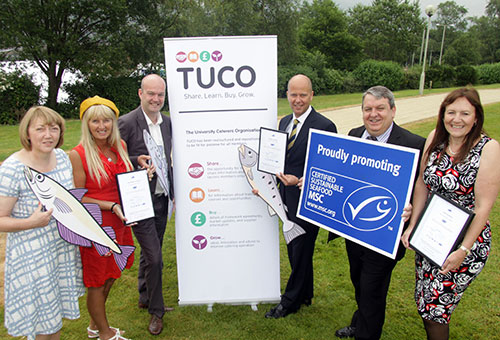
Julie Barker (far right) with Mike Haslin, chef operations officer at TUCO (third from left),
and Matthew White, TUCO vice-chair (fourth from left)











More from The Caterer


Most Popular


The Caterer People Summit 2026
 Thu May 14, 2026
 The Line, London
The Acorn Awards 2026
Sun Jun 7, 2026
The Cateys 2026
Tue Jul 7, 2026
Natural & Organic Food Show
Wed Sep 16, 2026ExCel London


The Caterer provides trusted hospitality news, analysis and trends for restaurants, hotels and catering professionals.

Jacobs Media is a company registered in England and Wales, company number 08713328. 3rd Floor, 52 Grosvenor Gardens, London SW1W 0AU.
© 2026 Jacobs Media
