


 Menu
Menu


‘Every pound spent will need to be maximised or eliminated’: Business leaders predict a bumpy ride for 2025
Pessimism has suffused the industry, with business leaders braced for a challenging year battered by extra costs
The past 18 months have seen a sharp decline in optimism among hospitality leaders, with the cost of labour and signs of consumers reining in spending among the challenges concerning operators.
The Hospitality Business Leader Survey 2025, produced by The Caterer and CGA by NIQ, sponsored by Bidfood and Compass Group, has exposed a 10% dip in optimism in the hospitality sector’s outlook, when compared to last year.
Of the operators who took part in the survey in April 2025, just 3% said they were “very optimistic” about the industry’s fortunes, with a further 30% describing themselves as “fairly optimistic”. At the time of the previous survey, 5% had felt very optimistic and 39% fairly optimistic. A further 35% of respondents said they were feeling “fairly pessimistic” and 5% “very pessimistic”, compared to 19% and 2% respectively in the last business leaders survey.
A challenging year
The results will come as a shock to few, with the industry’s brightest lights among those opening up about the challenges they’re facing. Tom Kerridge told The Guardian this month that he’s “never known fear like [that being felt in the industry currently]”.
He also acknowledged that of his six restaurants, just three were operating at a small profit, two were breaking even and one was losing “a lot of money”.
That same day Michel Roux issued a warning in The Times, saying: “There are going to be a lot more closures, and well-known high-end ones too.”
Reuben Pullan, senior insight consultant at CGA by NIQ, says: “The headline decline of business leaders’ confidence in the market of 10%, and the 19% rise in pessimism, is a stark warning that 2025 is expected to be a challenging year.
“The greatest perceived challenge for the next 12 months is government policy, which concerns almost all respondents to some degree, and within which 62% say they are very concerned about changes to employer National Insurance Contribution [NIC] thresholds.
“This is more than double the numbers who were very concerned by product inflation (26%), the cost of living crisis (25%) and energy costs (24%), which have already eroded margins in recent years.
“With tight financial room to manoeuvre, the industry response is limited, but the workforce is most likely to see the impacts of cost-saving efforts.”
Read More


Individual resilience in restaurants
The increase to employer Class 1 NICs from 13.8% to 15% was introduced in April alongside a reduction of the per-employee threshold at which employers become liable to pay, from £9,100 to £5,000 a year. It also coincided with a reduction in business rates relief and increases to the National Minimum Wage, which UKHospitality estimated would together cost the industry £3b.
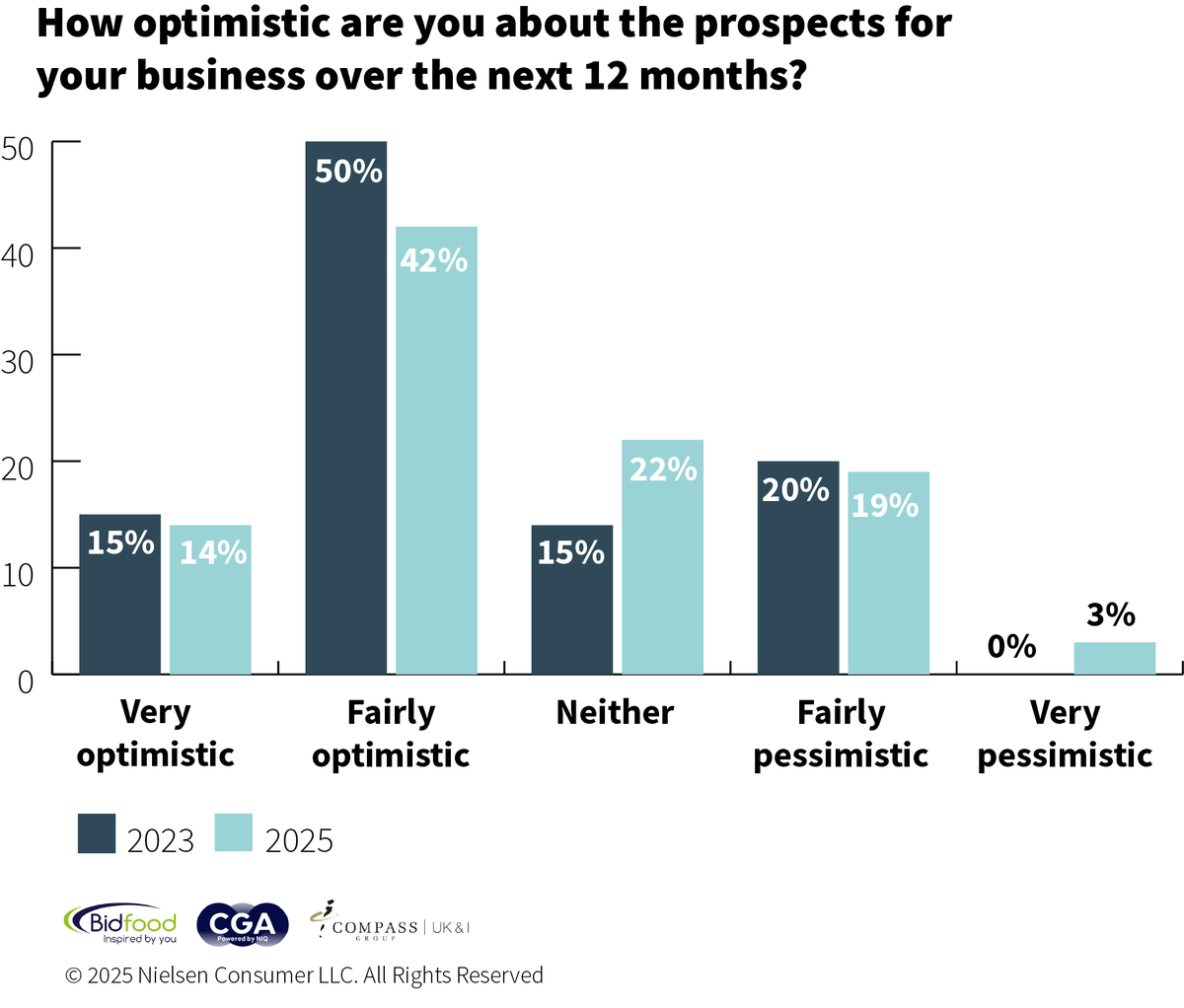
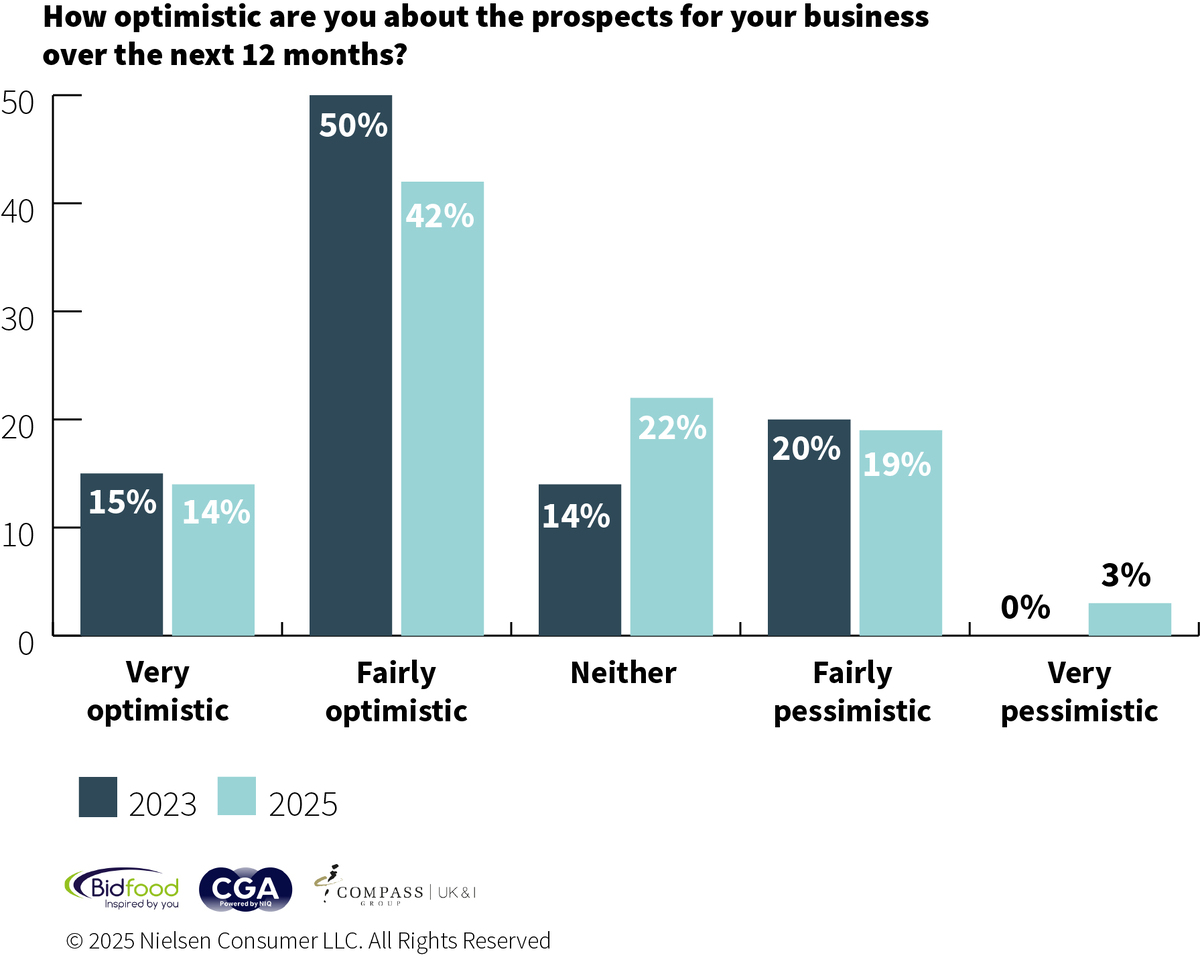
Despite the gloomy outlook for the sector as a whole, operators were generally more optimistic when it came to their own enterprises, with 14% feeling very optimistic, compared to 15% in 2023, and 42% fairly optimistic, compared to 50% in 2023.
Thom Elliot, co-founder of Pizza Pilgrims, which has 24 sites across the UK, said conditions were very challenging, but he had been encouraged by strong trading this spring. He explained: “It’s been tough and the increases to employer NICs have definitely not helped, but we’re feeling really good about the last six weeks’ trading.
“We’re seeing like-for-like growth. It’s not crazy growth, but there are opportunities there and our most recent opening in Edinburgh has outperformed our expectations.
“The battleground is undoubtedly harder. People are going out less, so you’ve really got to deliver, and the cost pressures mean there’s absolutely no margin for error. But resilient businesses will, I think, hold up, and hopefully the government will see the pressure they’ve put the sector under and consider that in their review of the rates system.”
Matt Thomas, managing director of Restaurant Associates, part of Compass Group UK & Ireland, said there was “some uncertainty about the future market”. He added: “As a food-focused business, we remain closely connected to our customers and clients, actively listening to their needs while demonstrating agility and an entrepreneurial spirit.
“Supporting this is our continued desire to raising standards and enhancing guest experiences. We achieve this through creating an inclusive culture that celebrates our people, ensuring they are happy, engaged and want to deliver excellence.”
Pessimism overtakes hoteliers
Among hoteliers, optimism was lower than in the wider industry, falling by 21% since 2023. None of the leaders said they felt very optimistic about the sector’s fortunes for the next 12 months, with just 25% feeling fairly optimistic, compared to 43% less than two years ago.
“Every key market we operate in – and we have 55 hotels across the UK and Ireland – is in decline”
The number of hoteliers feeling fairly pessimistic had more than doubled from 25% in 2023 to 46% this year, with a further 3% feeling very pessimistic.
Lousia Green, managing director of RBH management said: “2025 has certainly been challenging. Every key market we operate in – and we have 55 hotels across the UK and Ireland – is in decline, with Edinburgh the only exception. Some of these markets are now in double-digit decline, which is something we never envisaged and we hadn’t budgeted for.”
Green did highlight a mitigating factor in that the luxury end of the market was showing slightly stronger performance. She added that the performance of limited-service hotels in London also had to be read in the context of 2023 and 2024, which saw phenomenal rate performance. Green also believed there was still demand in the market, but anticipated that holding on to rates would be challenging.
“We can see that in the leisure market people are feeling the crunch”, she explained. “We didn’t see that last year, when we thought people would start cutting back, but it’s now coming to fruition.
“I haven’t got concerns about demand – it’s just capturing that rate. My expectation for the full year is that hopefully we’ll be flat. What we’re seeing into the summer months is that things are stabilising.”
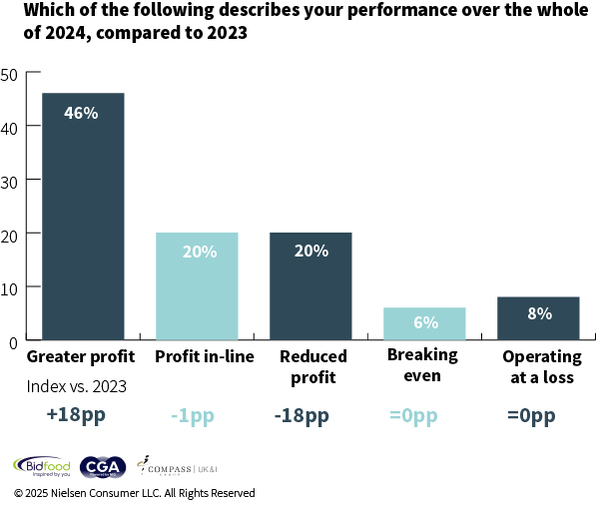
Despite the drops in optimism, profitability among respondents from across hospitality had risen since 2023. This year, 46% of respondents said they had seen profits increase, 20% reported they remained steady, 20% had seen a slight decline, 6% were breaking even and 8% were operating at a loss. Although, it should be noted that respondents completed the survey before April’s tax and National Minimum Wage increases came into effect.
Resiliency in foodservice
But despite these challenges, there was room for optimism, said Tim Adams, sales and marketing director at Bidfood. He added: “Our industry is characterised by the talented people who work within it and their creativity, resilience and adaptability. To survive and thrive on the road ahead, we must continue to be agile and innovative, and to foster strong collaboration across suppliers, wholesaler and operator partnerships.”
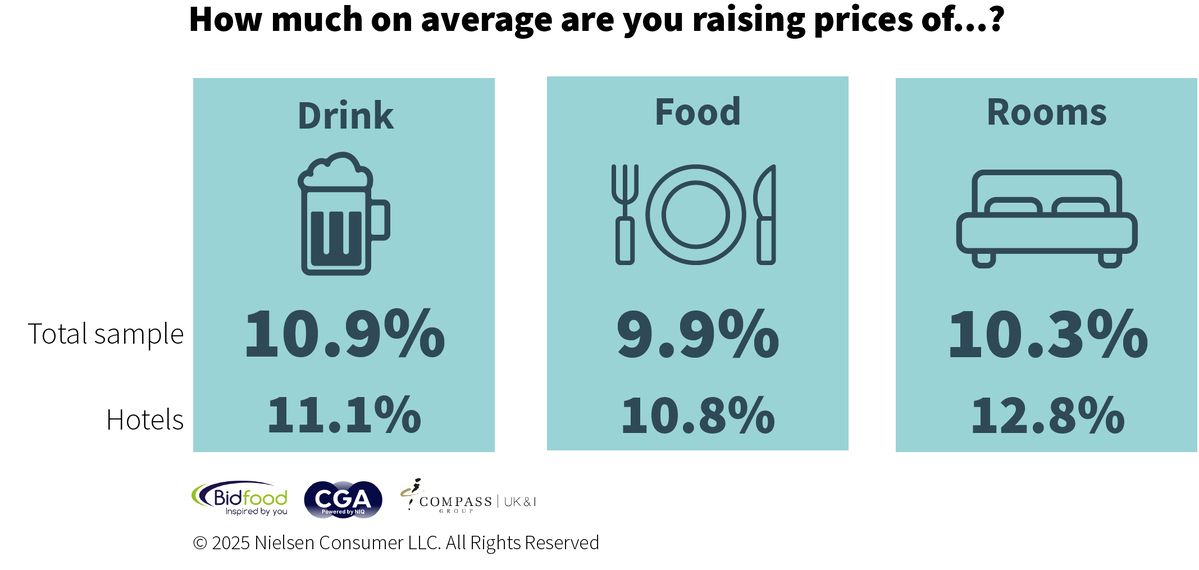
The increases to employer NICs were cited as leaders’ primary concern, and in response some 84% of operators said they were planning to pass on increased costs to their consumers, with prices expected to increase by more than 10% across food, drink and accommodation. However, there was concern that increased prices would hit trade, with 15% of respondents expecting frequency of visit to decrease greatly in the next 12 months and 56% anticipating a slight decrease.
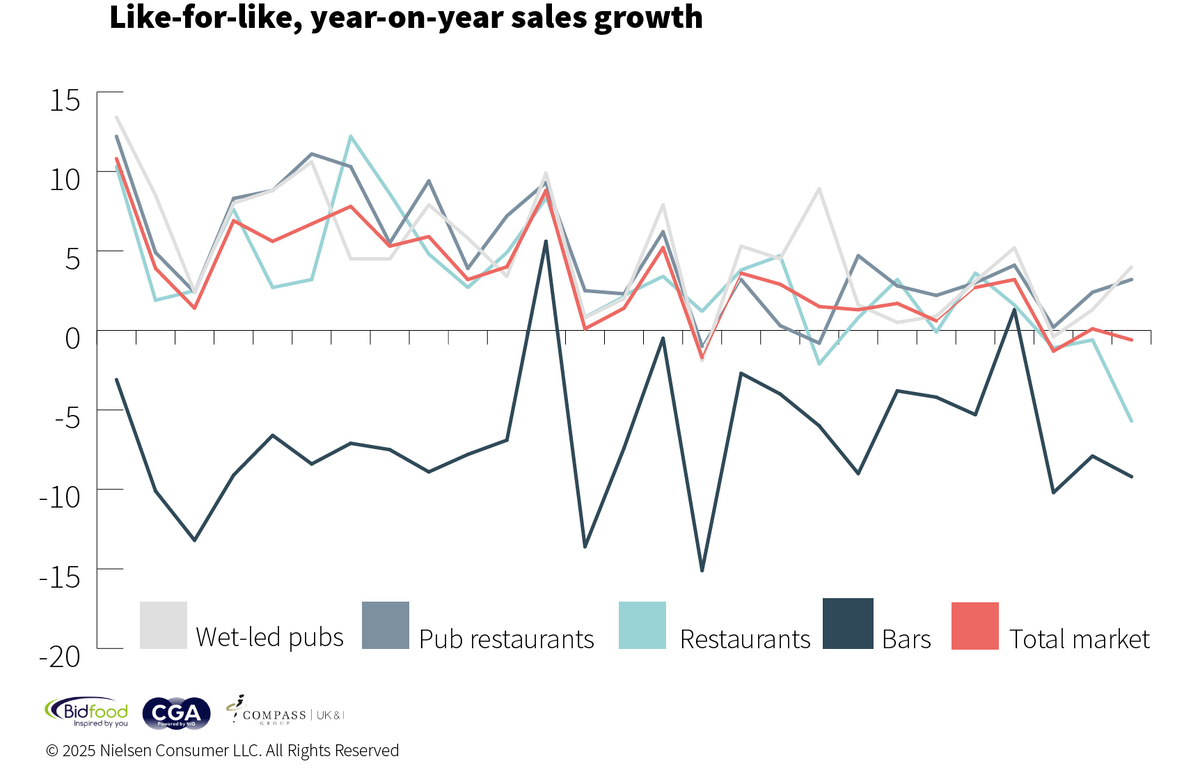
In the first three months of 2025, both bars and restaurants reported a decline in sales; however wet-led pubs and pub restaurants reported a slight uptick in like-for-like performance.
Pullan added: “CGA’s April Pulse report showed that 53% of consumers are still saying they are severely or moderately affected by the cost of living crisis, so many may question how much more consumers can shoulder. But cost is not the sole driver of choice. Consumers are still willing to spend for the right quality offer, and the value of visits to the sector goes even further, as 73% say it is the main way they socialise with friends and family.”
Caterers have seen the gap between price and value narrow too, according to Thomas. He said: “Historically, clients have chosen us for the added value we bring – particularly through our commitment to ESG practices and innovation. However, these are no longer differentiators but have become the norm.
“To truly maximise value, it has been important for us to show new levels of capability. Our recent acquisitions and diversifications into new markets has fuelled that ability, unlocking opportunities for customers across diverse sectors, including high-end global sports hospitality.”
Adams added that costs would inevitably come under more scrutiny: “Every pound spent will need to be maximised or eliminated. Consumers will only part with their pennies for what they see as true value or compelling experience.
Labour cuts
While staffing remained a key area of concern again, having ranked second in 2023 behind energy prices, the outlook regarding the issue has shifted significantly.
The number of operators who felt labour shortages would be a very significant issue in the next 12 months has reduced from 65% in 2023 to 27% this year, with the cost of employing individuals now more concerning.
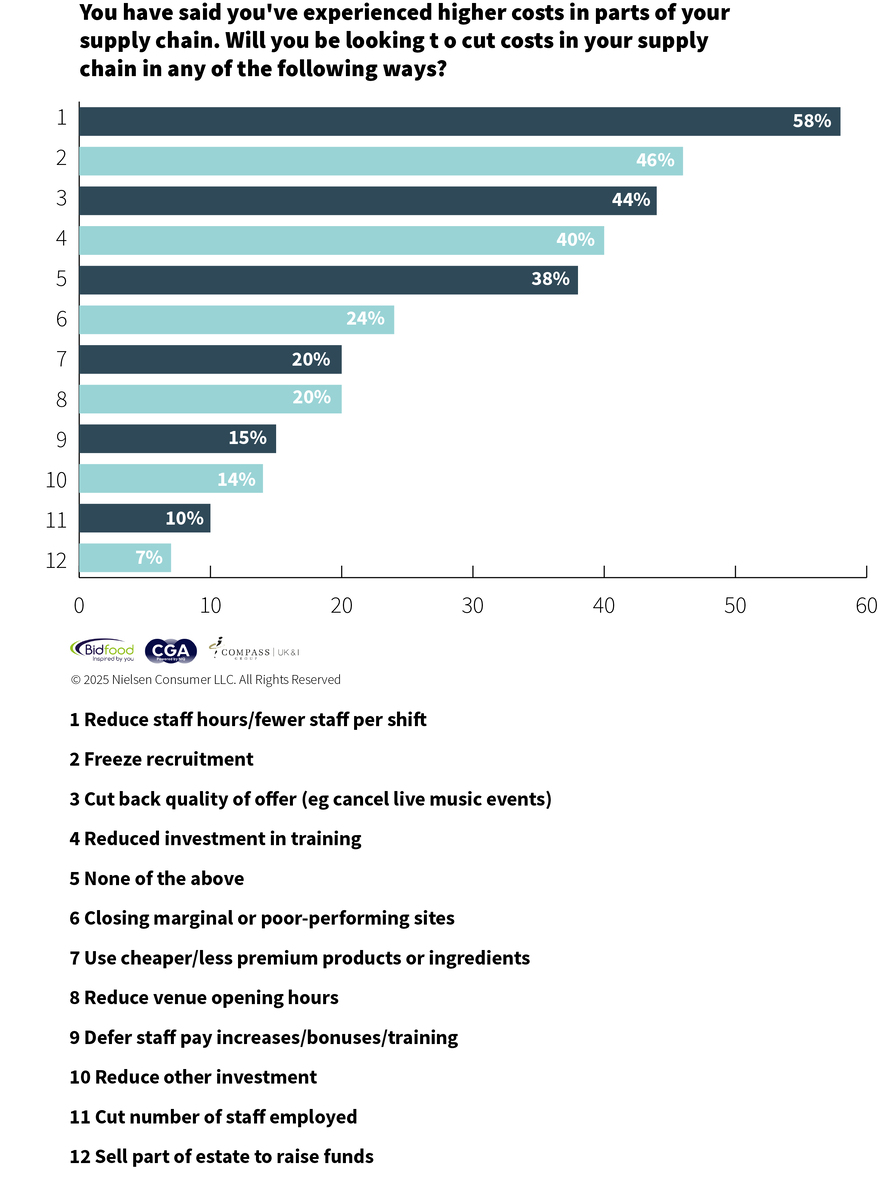
In response, operators are looking to reduce their workforce, with 58% of respondents saying they would look to cut staff hours, 46% looking to freeze recruitment and 44% cutting the number of people they employee. These figures rose to 60%, 52% and 46% respectively among hoteliers.
Green described the increase in the labour bill as “a direct challenge”, which the management company had costed at £2,500 per full-time employee. She said the impact could not be absorbed without looking at both pricing and efficiencies, as well as forensically examining strategy to drive top-line revenue.
After labour, hospitality leaders said food waste was expected to be the most significant social political issue in 2025, followed by supply chain interruptions, falling alcohol consumption and sustainable food and drink sourcing. Despite the pressures, there is an expectation of growth in some areas of the market, with upticks expected in both international tourism and delivery.
And yet operators still expressed a desire to expand, with 89% planning to open sites in 2025. In total some 71% of business leaders said they were aiming to open between one and two sites in the next 12 months. As well as this, 43% of respondents said they had made some sort of acquisition within the past 24 months, with 47% planning to make one over the next year.
The survey clearly shows there is concern for what the next 12 months will hold across all sectors of hospitality. However, as ever, there are those who continue to see opportunities and are ready to put their ingenuity to the test.
Bidfood: Consumers will only part with their pennies for what they see as true value
Tim Adams, sales and marketing director, Bidfood

Last year’s autumn Budget presented incredible challenges to the hospitality industry, and 2025 will bring with it a number of headwinds, from increases in NICs and the National Minimum Wage to rising inflation and the challenges and complexities of addressing new legislation. Costs will come under more scrutiny and every pound spent will need to be maximised or eliminated. Consumers will only part with their pennies for what they see as true value or compelling experience.
Despite these challenges, there is always room for optimism. Our industry is characterised by the talented people who work within it and their creativity, resilience and adaptability. To survive and thrive on the road ahead, we must continue to be agile and innovative and to foster strong collaboration across suppliers, wholesaler and operator partnerships.
That’s why Bidfood is delighted to support The Caterer’s Business Leaders Insight series. As one of the UK’s leading foodservice providers, we have a passion for great food and are always focused on going the extra mile for our customers. We know that providing great service alone isn’t enough, it’s about delivering real value. Whether it’s harnessing the power of emerging technologies like AI, sharing practical sustainability solutions, supporting cost-saving initiatives or leveraging the very latest food and drink trends to attract spend, our experts are on hand to share insight and help you stay ahead of the curve.
Compass Group UK and Ireland: Success is built on long-standing client partnerships
Matt Thomas, managing director, Restaurant Associates, part of Compass Group UK & Ireland

It is important to recognise that Restaurant Associates Group partners with a wide range of businesses and clients, and within this diversity there is naturally some uncertainty about the future market.
As a food-focused business, we remain closely connected to our customers and clients, actively listening to their needs while demonstrating agility and an entrepreneurial spirit.
Supporting this is our continued desire to raising standards and enhancing guest experiences. We achieve this through creating an inclusive culture that celebrates our people, ensuring they are happy, engaged and want to deliver excellence.
From a performance standpoint, Restaurant Associates is experiencing strong market growth and continues to demonstrate the strength of our propositions. This success is built on longstanding client partnerships and our ability to offer trusted guidance.
We are seeing the gap between price and value narrow. Historically, clients have chosen us for the added value we bring – particularly through our commitment to ESG practices and innovation. However, these are no longer differentiators but have become the norm.
To truly maximise value, it has been important for us to show new levels of capability. Our recent acquisitions and diversifications into new markets has fuelled that ability, unlocking opportunities for customers across diverse sectors, including high-end global sports hospitality.By championing thoughtful leadership and a commitment to delivering exceptional food through our outstanding teams, we are confident about weathering the market conditions.
Read the 2025 Business Leaders survey in full
Produced in association with





More from The Caterer
Most Popular


The Caterer People Summit 2026
 Thu May 14, 2026
 The Line, London
The Acorn Awards 2026
Sun Jun 7, 2026
The Cateys 2026
Tue Jul 7, 2026
Natural & Organic Food Show
Wed Sep 16, 2026ExCel London


The Caterer provides trusted hospitality news, analysis and trends for restaurants, hotels and catering professionals.

Jacobs Media is a company registered in England and Wales, company number 08713328. 3rd Floor, 52 Grosvenor Gardens, London SW1W 0AU.
© 2026 Jacobs Media
